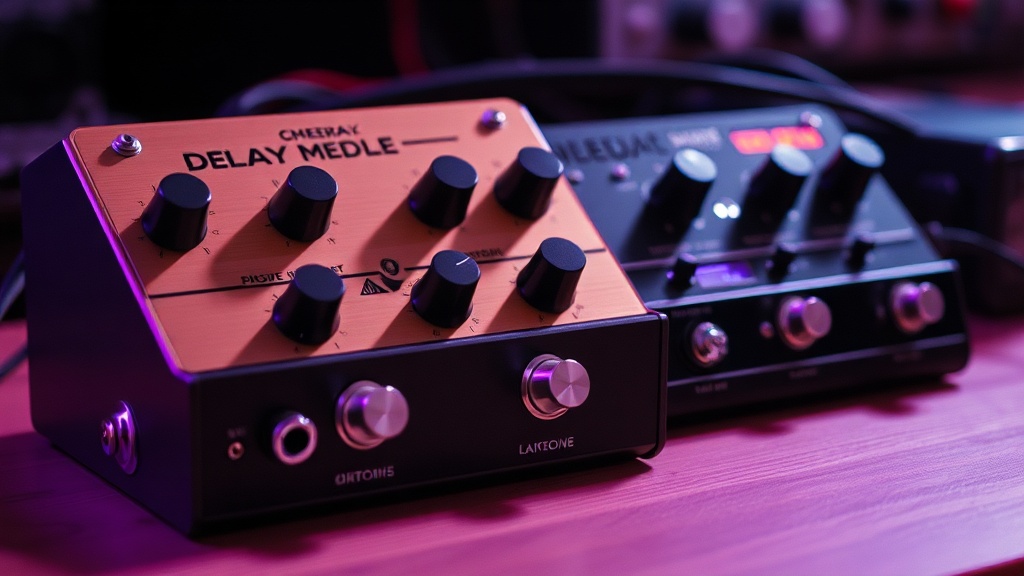
Analog Delay Pedals for Dreamy Shoegaze Textures

The Warmth of BBD Circuits
Selecting the Right Feedback Levels
Integrating with Reverb for Ambient Walls
Are you struggling to find that thick, washing sensation of sound that defines the best shoegaze tracks? This post breaks down the specific characteristics of analog delay pedals and lists the top models you'll need to build dreamy, textured soundscapes. We'll look at why analog delay behaves differently than digital and which specific pedals deliver that signature warmth and decay.
Why Use Analog Delay for Shoegaze?
Analog delay is preferred for shoegaze because it offers a natural, organic degradation of sound that digital delay cannot perfectly replicate. Unlike digital delay, which maintains a crisp, mathematical precision, analog delay uses physical components like BBD (Bucket Brigade Device) chips or tape loops to repeat a signal. This process introduces subtle pitch fluctuations and a soft, dark filtering effect that makes your guitar feel much wider and more immersive.
When you're playing through a heavy wall of fuzz, a digital delay can sometimes feel too "stiff." It sits on top of the mix like a separate layer. Analog delay, however, bleeds into the signal. It feels like it's part of the original note. This is why many players prefer the way these pedals interact with high-gain settings.
The lack of high-end clarity in an analog delay is actually its greatest strength in this genre. It fills the frequency gaps without cluttering the mix with harsh, high-pitched repeats. If you're already using heavy distortion, you might want to check out our previous piece on overdrive pedals that capture the gritty soul of desert rock to see how to layer your drive stages before hitting the delay.
The characteristic "warble" of an analog delay—often caused by voltage fluctuations or the aging of components—adds a sense of movement. It makes your textures feel alive. It's not a static effect; it's a living, breathing part of your pedalboard.
What Are the Best Analog Delay Pedals for Shoegaze?
The best analog delay pedals for shoegaze are those that offer long feedback loops and a high degree of control over the modulation and repeats. You want something that can go from a subtle rhythmic echo to a massive, overwhelming wash of sound with a single knob turn.
Here is a breakdown of the top contenders currently on the market:
- MXR M28s Delay: This is a modern take on the classic analog sound. It's compact and reliable, offering a very clean version of the analog warmth. It's great if you want the texture without the excessive "lo-fi" grit.
- Electro-Harmonix Memory Man: This is a legend for a reason. The way it handles modulation is incredibly lush. It creates those swirling, psychedelic textures that are a staple of the genre.
- Boss DM-2W Analog Delay: This pedal is incredibly user-friendly. It features a "intensity" knob that allows you to dial in the amount of modulation, which is perfect for creating those undulating soundscapes.
- Strymon Volante: While technically a tape delay, it's the gold standard for anyone wanting to push the limits of analog-style textures. It is expensive, but the depth of control is unmatched.
The Bucket Brigade Device (BBD) technology found in many of these pedals is what gives them that specific "warmth." The signal travels through a series of capacitors, losing a bit of high-end frequency at every step. This is why the repeats get darker and more muffled over time.
If you want something more budget-friendly, the Boss DM-2W is a fantastic starting point. It's reliable and won't break the bank. It gives you that classic, dark echo that sits beautifully behind a wall of fuzz.
How Much Does an Analog Delay Pedal Cost?
The cost of an analog delay pedal varies significantly based on the complexity of its circuitry and the brand's prestige, typically ranging from $100 to over $500.
| Pedal Model | Approximate Price (USD) | Best For... |
|---|---|---|
| Boss DM-2W | $150 - $170 | Beginners and reliability |
| MXR M28s | $160 - $190 | Compact setups |
| EHX Memory Man | $250 - $290 | Deep, psychedelic modulation |
| Strymon Volante | $450 - $500 | Professional, high-end tape textures |
When you're shopping, don't just look at the price tag. Look at the features. A pedal might be cheaper, but if it lacks a modulation knob, you might find it limiting for shoegaze. You need that ability to create movement. A static delay is just an echo; a modulated delay is an atmosphere.
It's worth noting that many of these pedals hold their value well on the used market. If you're on a budget, looking for a used EHX Memory Man can save you a significant amount of money. Just make sure to check the condition of the potentiometers (the knobs) to ensure they aren't scratchy.
How Do I Use Delay to Create Shoegaze Textures?
To create shoegaze textures, you should set your delay to a high feedback level and use a slow modulation rate to create a washing effect. You'll want the repeats to almost overlap with the original note, creating a "wall of sound" rather than distinct echoes.
Start by turning your feedback (or repeats) up. You want a long tail. If you're playing a chord, the delay should continue to ring out and swell. Then, introduce modulation. If your pedal has a modulation knob, turn it up until the repeats start to drift slightly in pitch. This creates that dreamy, ethereal feeling that makes the genre so captivating.
The interaction between your fuzz and your delay is everything. A common technique is to place the delay after your fuzz pedal. This allows the delay to catch the massive, distorted signal and smear it across the stereo field (if you're using a stereo setup). If you put the delay before the fuzz, the fuzz will often "eat" the delay, making it sound much more aggressive and less dreamy.
Try this: turn your volume up, hit a heavy fuzz, and then slowly increase the delay feedback. You'll hear the sound expand and fill the room. It's a powerful way to build tension in a song. It's not just about playing notes; it's about managing the space around the notes.
One thing to watch out for is your headroom. If your delay has too much gain, it might clip your amp in an unpleasant way. You want the texture to be lush, not a chaotic mess of digital clipping. Adjust your settings incrementally. Small changes can make a huge difference in how the texture feels.
If you find yourself needing more space, consider using a reverb pedal after your delay. This is a common way to achieve that "infinite" sound. The delay provides the rhythmic movement and the darkness, while the reverb provides the massive, cavernous space. Together, they create the ultimate shoegaze atmosphere.
Don't be afraid to experiment with your delay time. Sometimes, a very short delay time can create a "doubling" effect that makes your guitar sound much thicker. Other times, a very long delay time can turn your playing into a slow, drifting ambient piece. Both are perfectly valid within the genre.
The key is to listen to how the repeats interact with the sustain of your notes. If the delay feels too "jumpy," turn down the modulation. If it feels too static, turn it up. You're looking for that sweet spot where the sound feels like it's floating.
Ultimately, your gear is a tool for expression. Whether you're using a $150 Boss or a $500 Strymon, the goal is to find the sound that resonates with the music you're trying to make. There's no single "correct" way to do this—only what sounds right to your ears.