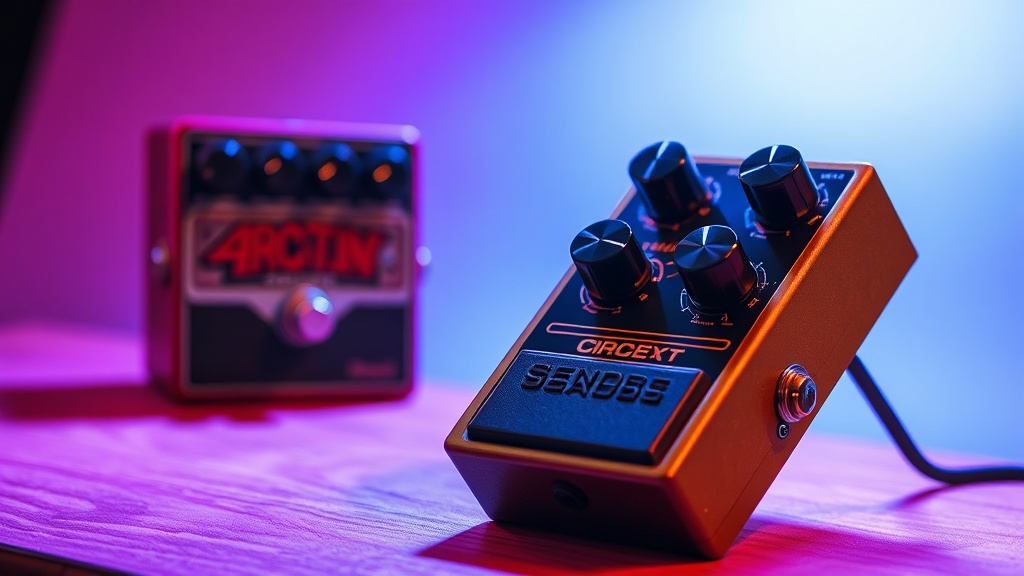
Overdrive Pedals That Capture the Gritty Soul of Desert Rock

Have you ever spent hours twisting knobs only to realize your guitar still sounds like it belongs in a sterile studio rather than a dusty canyon?
This breakdown covers the specific overdrive and fuzz circuits that define the heavy, low-end focused desert rock sound and why your choice of clipping stage is the most important decision you'll make for your live rig. We're looking at how to get that sagging, saturated grit without losing the clarity needed to keep your riffs from turning into a pile of sonic sludge. Desert rock (or stoner rock, if you're into labels) isn't just about turning the volume to eleven; it's about a specific frequency response that mimics the dry, expansive heat of the Southwest. If you've been struggling to make your riffs feel heavy without sounding 'metal,' the problem is almost certainly in how you're hitting your preamp.
Living in Tucson, I see a lot of touring bands come through with boards that are way too polite. They've got three different 'transparent' drives that do nothing but add a bit of sparkle. Sparkle is great for indie pop, but it doesn't do much when you're trying to emulate the sound of a generator-powered stack in the middle of the Mojave. You need weight. You need a bit of ugliness. Most importantly, you need to understand how your pedals interact with the natural compression of a tube amp that's working for its living.
What is the difference between hard and soft clipping for rock tones?
Understanding the distinction between hard and soft clipping is the first step toward building a board that doesn't suck. Soft clipping happens when the diodes are placed in the feedback loop of the op-amp. This results in a smoother, more rounded waveform—think of the classic 'hump' in a Tube Screamer. It's creamy and predictable. For desert rock, soft clipping is often used as a 'push' to tighten up a fuzzy low end, but it rarely provides the primary character of the sound. It's the supporting actor, not the lead.
Hard clipping, on the other hand, happens when the diodes are connected from the signal path to the ground after the amplification stage. This chops the top and bottom off your waveform much more aggressively. The result is a square-wave-adjacent sound that feels more like a small explosion than a gentle push. This is where you get that 'velcro' rip and the aggressive bite that allows a guitar to stand its ground against a heavy-handed drummer. If you want to dig deeper into the electrical engineering behind this,